
The year 2026 marks a pivotal transition in the world of technology. We have moved past the initial excitement of simple chat interfaces and entered the era of Agentic Artificial Intelligence and enterprise-scale autonomous systems. For professionals in the United States, staying competitive in this fast-moving landscape requires more than just a basic understanding of large language models. It requires recognized credentials that prove your ability to architect, deploy, and govern sophisticated machine learning solutions.
- The Evolution of Artificial Intelligence Training in 2026
- 1. AWS Certified Generative AI Developer: Professional
- 2. Google Professional Machine Learning Engineer
- 3. Microsoft Certified: Azure AI Engineer Associate
- 4. Stanford Professional Certificate in Artificial Intelligence
- 5. IBM AI Engineering Professional Certificate
- 6. MIT xPRO Professional Certificate in Machine Learning and AI
- 7. IAPP Certified Artificial Intelligence Governance Professional (AIGP)
- Specialized AI Certifications for Niche Roles
- Comparing the Top AI Certifications in 2026
- Preparing for Success: Tips from a Top Content Writer
- The Financial Benefits of AI Certification in the USA
- Step-by-Step Roadmap to Choosing Your Certification
- Conclusion
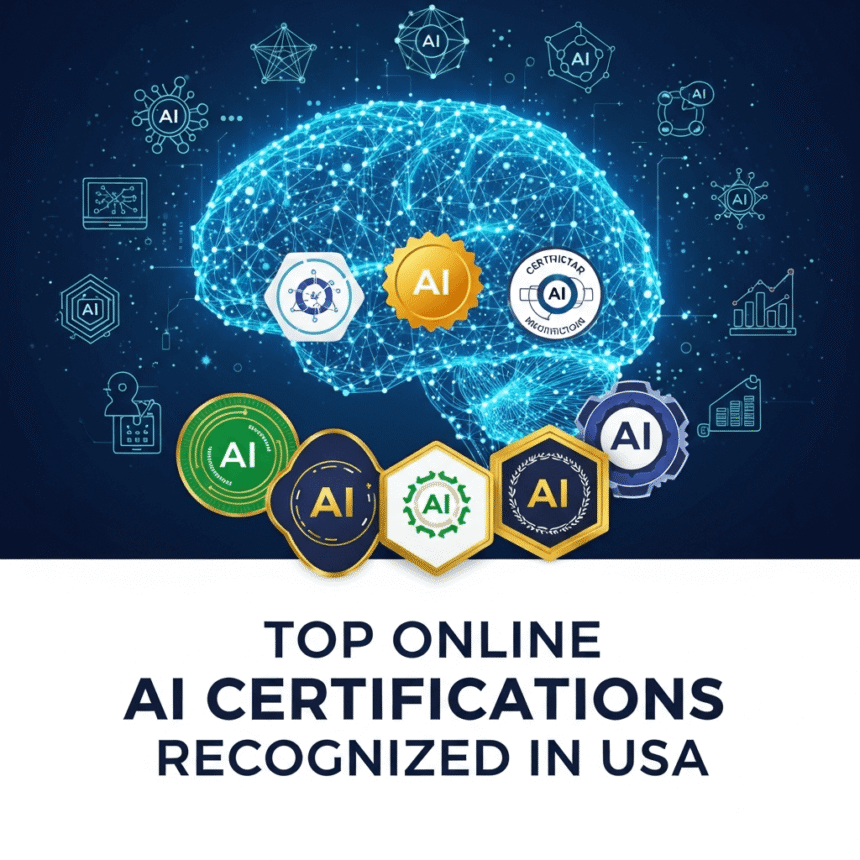
This guide provides a comprehensive analysis of the top online AI certifications recognized in the USA as of January 2026. Whether you are a software engineer looking to pivot or a business leader aiming to oversee AI transformation, these programs offer the technical depth and industry credibility needed to secure high-value roles in the modern economy.
The Evolution of Artificial Intelligence Training in 2026
The demand for AI expertise in the US job market has shifted. In previous years, general data science certificates were sufficient. Today, employers are looking for specialized skills in retrieval-augmented generation (RAG), vector databases, and AI ethics. Major tech hubs from Silicon Valley to the Research Triangle are prioritizing candidates who hold certifications from major cloud providers or prestigious academic institutions.
The current trend in 2026 focuses heavily on “Agentic AI,” where models are trained to act as autonomous teammates rather than just tools. This shift has led to the creation of new certification tracks that specifically address the integration of foundation models into business workflows.
1. AWS Certified Generative AI Developer: Professional
Released in early 2026, the AWS Certified Generative AI Developer – Professional is currently the most sought-after credential for backend developers and AI engineers. This certification validates your ability to build production-ready applications using Amazon Bedrock and complex RAG architectures.
Key Domains Covered
- Implementing foundation models and fine-tuning strategies.
- Architecting Agentic AI using Bedrock AgentCore.
- Deploying and managing vector databases for real-time data retrieval.
- Optimizing model performance and managing inference costs.
Why It Is Recognized
Amazon Web Services powers a significant portion of the enterprise cloud market in the USA. This certification is a direct signal to recruiters that you can handle the architectural demands of scaling AI within a secure, cloud-native environment.
Live Daily Information: January 2026 Update
AWS has officially announced that the older “AWS Certified Machine Learning – Specialty” exam will be retired on March 31, 2026. Professionals are encouraged to move toward the new Generative AI Professional track or the Machine Learning Engineer – Associate track to stay current with 2026 industry standards.
Source Link: AWS Training and Certification
2. Google Professional Machine Learning Engineer
Google has long been a pioneer in deep learning and neural network research. Their Professional Machine Learning Engineer certification remains a gold standard for those working with TensorFlow and Google Cloud AI. In 2026, the curriculum has been updated to include extensive modules on Vertex AI and the deployment of multimodal models.
Focus Areas
- Framing ML problems and architecting end-to-end solutions.
- Building and training models with advanced optimization techniques.
- Scaling ML pipelines using Kubeflow and Vertex AI.
- Ensuring model explainability and fairness in production.
Career Impact
In the United States, holders of this certification often command salaries exceeding $150,000, particularly in sectors like fintech and healthcare where Google’s data processing capabilities are highly valued.
Source Link: Google Cloud AI Certifications
3. Microsoft Certified: Azure AI Engineer Associate
With the deep integration of OpenAI services into the Azure ecosystem, the Microsoft Certified: Azure AI Engineer Associate (AI-102) has become essential for developers working in corporate America. This certification focuses on using Azure Cognitive Services and Azure OpenAI to build intelligent applications.
Core Curriculum
- Designing and implementing Azure AI solutions.
- Integrating speech, vision, and natural language processing.
- Utilizing Azure Bot Services for conversational AI.
- Monitoring and maintaining AI workloads in an enterprise setting.
Industry Recognition
Microsoft’s strong presence in the Fortune 500 makes this one of the most recognized certifications for enterprise-level AI engineering.
Source Link: Microsoft Azure AI Certifications
4. Stanford Professional Certificate in Artificial Intelligence
For those seeking academic prestige alongside technical rigor, the Stanford Center for Professional Development offers an online certificate program that is highly regarded by top-tier tech firms in the USA.
Program Structure
The program consists of several intensive courses including:
- XCS229: Machine Learning.
- XCS224N: Natural Language Processing with Deep Learning.
- XCS236: Deep Generative Models.
Requirements and Intensity
Unlike many vendor-specific certs, Stanford’s program requires a strong foundation in college-level calculus, linear algebra, and probability. It is an “on-demand, live” hybrid program that typically takes 10 weeks per course to complete.
Source Link: Stanford Online AI Professional Program
5. IBM AI Engineering Professional Certificate
Offered through Coursera, this six-course program is designed for individuals who want a practical, vendor-agnostic foundation in machine learning and deep learning. IBM’s curriculum is famous for its hands-on approach, requiring students to complete a series of real-world projects.
Skills Acquired
- Mastery of Python libraries like Scikit-Learn, PyTorch, and Keras.
- Understanding of supervised and unsupervised learning algorithms.
- Building and deploying deep learning models for computer vision and NLP.
- Scaling AI models using Apache Spark.
Target Audience
This is an ideal certification for career changers who have some programming experience and want to build a portfolio that attracts attention from US-based tech companies.
Source Link: IBM Professional Certificates
6. MIT xPRO Professional Certificate in Machine Learning and AI
MIT’s xPRO program offers a high-level, strategic perspective on AI while maintaining technical depth. This is particularly popular among mid-to-senior level engineers and technical managers in the United States who need to lead AI initiatives.
Highlights
- Curriculum developed by world-renowned MIT faculty.
- Focus on both the theory and the application of neural networks.
- Modules on generative AI and the future of work.
- Access to a global alumni network that is highly active in the US tech scene.
Source Link: MIT xPRO AI Program
7. IAPP Certified Artificial Intelligence Governance Professional (AIGP)
As the US government begins to implement more stringent regulations on AI, the need for governance and ethics experts has skyrocketed. The International Association of Privacy Professionals (IAPP) launched the AIGP credential to address this gap.
Why It Matters in 2026
Companies are now legally and ethically responsible for the outputs of their AI systems. This certification proves you understand the legal landscape, risk management frameworks, and ethical considerations necessary for responsible AI deployment.
Who Should Get It?
- Legal professionals and compliance officers.
- AI project managers and product owners.
- Data scientists focused on model auditing and fairness.
Source Link: IAPP AIGP Certification
Specialized AI Certifications for Niche Roles
While the general certifications cover the broad landscape, certain high-growth sectors in the USA require specialized training.
NVIDIA Deep Learning Institute (DLI)
For those focused on hardware acceleration and edge AI, NVIDIA’s DLI certifications are unmatched. They provide specific credentials for Jetson AI and high-performance computing (HPC) environments.
USAII Certified Artificial Intelligence Scientist (CAIS)
This program is tailored for senior leaders and executives who need to understand AI from a strategic and financial perspective. It focuses on the ROI of AI initiatives and organizational transformation.
Comparing the Top AI Certifications in 2026
To help you decide which path to take, we have broken down the key metrics for the most popular programs available this year.
| Certification Name | Provider | Target Level | Estimated Cost | Salary Potential (USA) |
| Generative AI Developer (Prof) | AWS | Advanced | $300 | $140,000 – $185,000 |
| Professional ML Engineer | Intermediate | $200 | $135,000 – $175,000 | |
| Azure AI Engineer Associate | Microsoft | Intermediate | $165 | $120,000 – $160,000 |
| AI Professional Certificate | Stanford | Advanced | $1,950+ | $160,000 – $220,000 |
| AI Engineering Prof Cert | IBM | Beginner | $39/mo | $110,000 – $150,000 |
| AI Governance Prof (AIGP) | IAPP | Specialized | $550 | $130,000 – $170,000 |
Preparing for Success: Tips from a Top Content Writer
As someone who has seen the rise and fall of various tech trends, I can tell you that the certificate is only the beginning. To truly stand out in the US job market in 2026, you must pair your certification with a public portfolio.
Build a “Day Zero” Portfolio
Every major certification now includes a capstone project. Do not just do the bare minimum. Use your certification training to solve a specific problem in a high-value industry like renewable energy, decentralized finance, or precision medicine.
Focus on MLOps
Earning a certificate in model building is great, but companies are currently desperate for people who can keep models running. Understanding the “Operations” side of AI (MLOps) is the secret to reaching the upper tiers of salary brackets.
Continuous Learning
The information provided here is current as of January 2026, but in this field, six months can change everything. Follow industry blogs from OpenAI, Anthropic, and Google Research to stay ahead of the next wave of “Agentic” updates.
The Financial Benefits of AI Certification in the USA
Recent data from late 2025 and early 2026 suggests that professionals with at least one recognized AI certification earn roughly 25 to 40 percent more than their non-certified counterparts. In high-cost-of-living areas like San Francisco, Seattle, and New York City, this difference can be even more pronounced.
Beyond the immediate salary bump, these certifications provide job security. As traditional software engineering roles evolve, those with the credentials to manage AI-driven code generation and autonomous systems will be the ones leading the departments of tomorrow.
Step-by-Step Roadmap to Choosing Your Certification
- Identify Your Goal: Are you looking to build (Developer), manage (Project Manager), or lead (Executive)?
- Assess Your Prerequisites: If you lack math skills, start with IBM or Google Foundations. If you are a math wizard, look at Stanford or MIT.
- Choose Your Ecosystem: Does your current or target employer use AWS, Azure, or Google Cloud? Align your first certification with their stack.
- Schedule the Exam: Don’t wait until you feel “ready.” Set a date three months out to create a sense of urgency.
Conclusion
The landscape of online AI certifications in the United States is more robust and diverse than ever. Whether you choose the cloud-native path of AWS and Microsoft or the prestigious academic route of Stanford and MIT, the investment in your education today will pay dividends for the rest of the decade. The shift toward Generative and Agentic AI in 2026 has created a unique window of opportunity for those willing to put in the work and validate their skills with industry-recognized credentials.