
The technological landscape of the United States has undergone a seismic shift as we move into 2026. Artificial Intelligence is no longer a niche interest for computer scientists but a core competency required across every major American industry: from finance on Wall Street to healthcare in the Midwest and tech innovation in Silicon Valley. For those standing at the threshold of this revolution, identifying the right educational path is the first step toward a future-proof career. This guide explores the most prestigious, effective, and accessible AI courses for beginners available in the United States today.
- Why Starting Your AI Journey in 2026 is Essential
- Top 5 AI Courses for Beginners in the United States
- 1. AI for Everyone by DeepLearning.AI
- 2. Google AI Essentials
- 3. Stanford University: Artificial Intelligence Professional Program
- 4. Microsoft: Generative AI for Beginners
- 5. IBM: Introduction to Artificial Intelligence
- Detailed Comparison of Popular AI Certifications
- The Rise of Agentic AI: What to Watch in 2026
- Essential Skills for the AI-Ready Professional
- 1. Data Literacy
- 2. Basic Mathematics and Statistics
- 3. Critical Thinking and Ethics
- 4. Communication and Collaboration
- How to Choose the Right AI Course for You
- Future Career Paths and Salaries in the US AI Market
- Live Daily Information: Current Enrollment Windows
- Conclusion and Final Thoughts
Why Starting Your AI Journey in 2026 is Essential
The demand for AI literacy has reached an all-time high. Recent employment data from early 2026 suggests that over 70 percent of new job postings in the United States now list AI or machine learning familiarity as a preferred skill. This trend is not limited to engineering roles. Marketing managers, legal consultants, and administrative professionals are increasingly using agentic AI systems to automate complex workflows. By enrolling in a beginner-friendly course, you are not just learning to use a tool: you are learning to navigate the new language of the global economy.
The Financial Advantage of AI Skills
Economic reports indicate that entry-level professionals with verified AI certifications in the USA can command salaries significantly higher than their peers. For instance, a Junior Data Scientist in a major tech hub like Austin or Seattle can earn between $151,000 and $207,000 per year. Even non-technical roles, such as Generative AI Content Creators, are seeing average annual pay scales ranging from $58,000 to $107,000. These figures highlight the immediate return on investment for high-quality education.
Top 5 AI Courses for Beginners in the United States
Finding a course that balances theoretical depth with practical application is vital. Below are the top-rated programs currently accepting enrollments for the Winter and Spring 2026 terms.
1. AI for Everyone by DeepLearning.AI
Led by Dr. Andrew Ng, a global pioneer in the field, this course remains the gold standard for non-technical beginners. It is hosted on the Coursera platform and is specifically designed to demystify the technology for business leaders and curious individuals alike.
What You Will Learn:
- The difference between Narrow AI and General AI.
- How to identify opportunities for AI implementation in your specific business.
- The reality of what AI can and cannot do: avoiding the “hype” trap.
- Building an AI strategy for your organization.
- Understanding the ethical implications of automated decision-making.
Key Information:
- Platform: Coursera (DeepLearning.AI).
- Cost: Approximately $49 for the certificate, or free to audit.
- Duration: roughly 6 to 10 hours.
- Enrollment Status: Open for January 2026.
2. Google AI Essentials
Google has consistently been at the forefront of the AI movement in the US. Their “AI Essentials” program is a practical, hands-on certification that focuses on the tools people use every day. It is highly recommended for those who want to see immediate productivity gains in their current roles.
Curriculum Highlights:
- Master prompt engineering: learning the five steps to writing effective instructions.
- Using Gemini and other large language models for content generation.
- Responsible AI practices: ensuring security and inclusivity.
- Real-world projects using Google Workspace and AI-integrated tools.
Live 2026 Update: Google is currently offering a special “AI for Students” promotion. Eligible college students in the United States can gain free access to Google AI Pro if they sign up before the January 31, 2026 deadline. This includes advanced training modules and premium tool access.
3. Stanford University: Artificial Intelligence Professional Program

For those seeking the prestige of an Ivy-plus institution, Stanford Online offers a professional certificate that is accessible to beginners with a basic understanding of mathematics. This program bridges the gap between introductory concepts and graduate-level theory.
Course Modules for 2026:
- Principles and Techniques: Starts March 9, 2026.
- Machine Learning Foundations: Enrollment opens April 13, 2026.
- Natural Language Processing with Deep Learning: Live sessions from February 23 to May 3, 2026.
Why Choose Stanford:
Stanford’s proximity to Silicon Valley ensures that their curriculum is influenced by the latest industry trends. The program provides direct feedback from course facilitators and allows you to join a cohort of motivated professionals.
4. Microsoft: Generative AI for Beginners
Microsoft’s 2026 curriculum is one of the most comprehensive free resources available. It is hosted on GitHub and Microsoft Learn, making it ideal for self-paced learners who prefer a more modular approach.
Core Topics:
- The history of Generative AI and how it works.
- Building AI-powered applications without deep coding knowledge.
- Understanding Small Language Models (SLMs) vs. Large Language Models (LLMs).
- Securing your business’s AI systems against modern vulnerabilities.
5. IBM: Introduction to Artificial Intelligence
IBM has a long-standing history of computing excellence. Their beginner course focuses on the “Business Logic” of AI, teaching students how to mitigate risks while maximizing ROI. It covers the foundations of neural networks and robotics, providing a well-rounded view of the entire field.
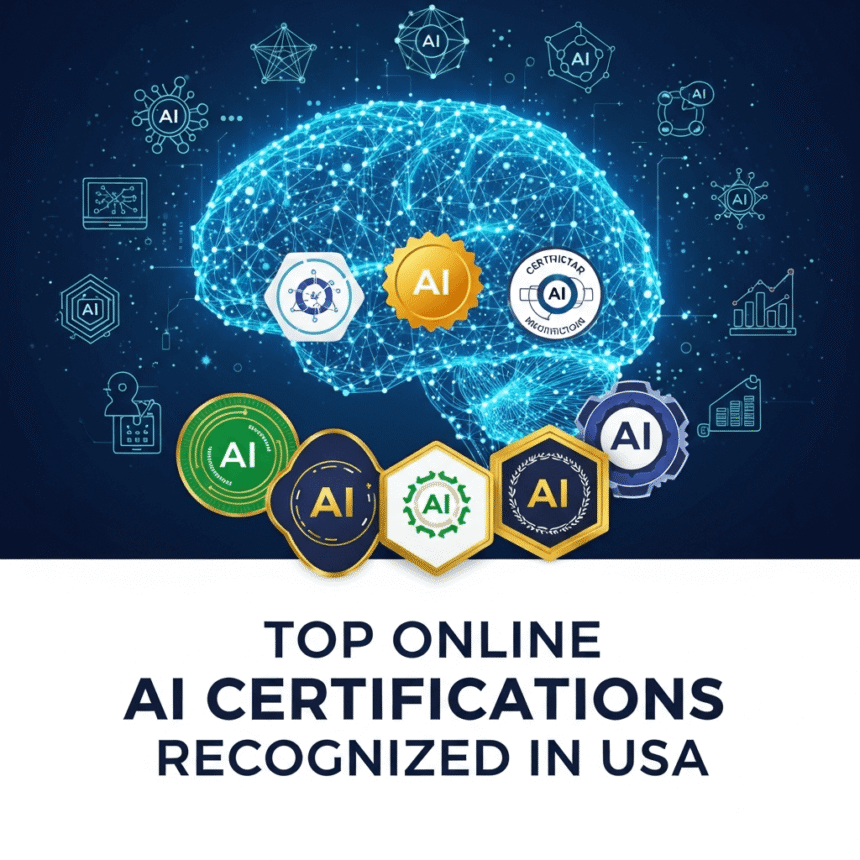
Outcome: Students earn a shareable IBM badge that is highly recognized by recruiters in the enterprise software and consulting sectors.
Detailed Comparison of Popular AI Certifications
When choosing a program, it is helpful to look at how different certifications stack up against one another in terms of cost and depth.
- DataCamp AI Fundamentals: Best for business leaders. Cost is roughly $25 per month. Focuses on core AI and ethics.
- UT Austin Online Master’s (MSAI): A top-tier academic option. Total cost is approximately $10,000. Requires a longer commitment of 18 to 36 months but offers massive career leverage.
- Purdue University Online: Offers a Master of Science in AI with concentrations in Management and Policy. Credits from their introductory certificate roll directly into the degree program. Cost is $933 per credit for the 2025/2026 academic year.
- Harvard Executive Education: “Leading in Artificial Intelligence” is a high-impact in-person program in Cambridge, MA. The cost is $11,700, and it is designed for senior leaders who need to shape policy and strategy.
The Rise of Agentic AI: What to Watch in 2026
The hottest trend in AI education for 2026 is “Agentic AI.” While 2024 and 2025 focused on simple prompt engineering and Retrieval-Augmented Generation (RAG), the current year is all about autonomous agents. These are systems that can not only answer questions but also perform tasks across different software platforms independently.
Courses like those from NVIDIA and specialized modules in the Stanford Professional Program are now including “Agentic Workflows” in their beginner tracks. Learning how to manage these agents is considered one of the most valuable high-income skills of this year.
Essential Skills for the AI-Ready Professional
To succeed in any of these courses, you do not necessarily need a degree in computer science. However, cultivating the following foundational skills will make your learning journey much smoother.
1. Data Literacy
AI models are only as good as the data they are trained on. Understanding how to collect, clean, and interpret data is vital. Many students find that taking a short course in SQL or Python’s Pandas library alongside their AI studies provides a significant advantage.
2. Basic Mathematics and Statistics
While many beginner courses are “math-light,” having a grasp of probability and logic will help you understand how models make predictions. You do not need to be a calculus expert, but knowing the basics of linear algebra can open doors to more advanced machine learning topics later on.
3. Critical Thinking and Ethics
In 2026, “Responsible AI” is a mandatory subject. Employers are looking for people who can identify bias in AI outputs and ensure that automated systems are used fairly. This involves a mix of philosophy, law, and social science.
4. Communication and Collaboration
AI is a team sport. Whether you are working with designers, engineers, or business stakeholders, you must be able to explain technical concepts in simple terms. This is why many US-based programs now include modules on “AI Presentation Skills.”
How to Choose the Right AI Course for You
With so many options, the choice can feel overwhelming. Use the following checklist to evaluate your needs before enrolling.
- What is your primary goal? Are you looking for a quick productivity boost (Google AI Essentials), a total career change (UT Austin MSAI), or an executive-level strategic overview (Harvard/MIT)?
- How much time can you commit? Self-paced programs like Microsoft’s are great for busy schedules, while cohort-based programs like Stanford’s require specific weekly commitments.
- Does the course offer hands-on projects? Avoid courses that are 100 percent video lectures. Look for programs that require you to build a simple app, write a prompt library, or analyze a dataset.
- What is the credential’s value? If you plan to apply for jobs in the US, look for certifications from recognized universities or industry giants like Google, IBM, and Microsoft.
Future Career Paths and Salaries in the US AI Market
The career outlook for AI-literate professionals in the United States is exceptionally bright. As of January 2026, here are some of the most in-demand entry-level roles.
- AI Security and Risk Analyst: These professionals monitor AI systems for safety and compliance. With new regulations being passed in 2025 and 2026, this role is critical. Salary ranges from $83,000 to $156,000.
- Junior Data Scientist: A classic entry point into the technical side of the field. Expected salary is between $151,000 and $207,000.
- AI Research Assistant: Ideal for those who enjoy the academic and experimental side of tech. Salaries range from $81,000 to $133,000.
- Generative AI Content Specialist: A role that blends creativity with technical prompting. Salaries are roughly $58,000 to $107,000.
Live Daily Information: Current Enrollment Windows
Staying updated with deadlines is crucial for anyone looking to start their education immediately. Here are the live enrollment windows for January and February 2026.
- Stanford Online: Individual enrollments for “Deep Generative Models” and “Deep Learning” are open now for terms starting in late January and early February 2026.
- Google Cloud: The “Introduction to Generative AI” course is currently free and open for immediate start via Google Cloud Skills Boost.
- Harvard University: Registration for the “Generative AI: How to Use It and Why It Matters” online program closes on March 2, 2026.
- Purdue University: Applications for the Spring B term are currently being processed.
Conclusion and Final Thoughts
The journey into artificial intelligence begins with a single step: choosing a curriculum that aligns with your passions and professional goals. Whether you are looking to save time at work with Google’s productivity tools or aiming for a leadership role via Stanford’s rigorous certifications, the resources available in the United States in 2026 are more robust than ever before. The key is to start now. The rapid pace of development means that the skills you acquire today will be the foundation of your success for decades to come.
As the US continues to lead the global AI conversation, being a part of that dialogue requires more than just knowing how to use a chatbot. It requires a deep understanding of the ethics, logic, and practical applications of these powerful systems. By choosing any of the courses mentioned above, you are placing yourself at the forefront of the most significant technological shift in human history.
Would you like me to research the specific financial aid and scholarship options available for the Stanford or Purdue AI programs for the 2026 academic year?