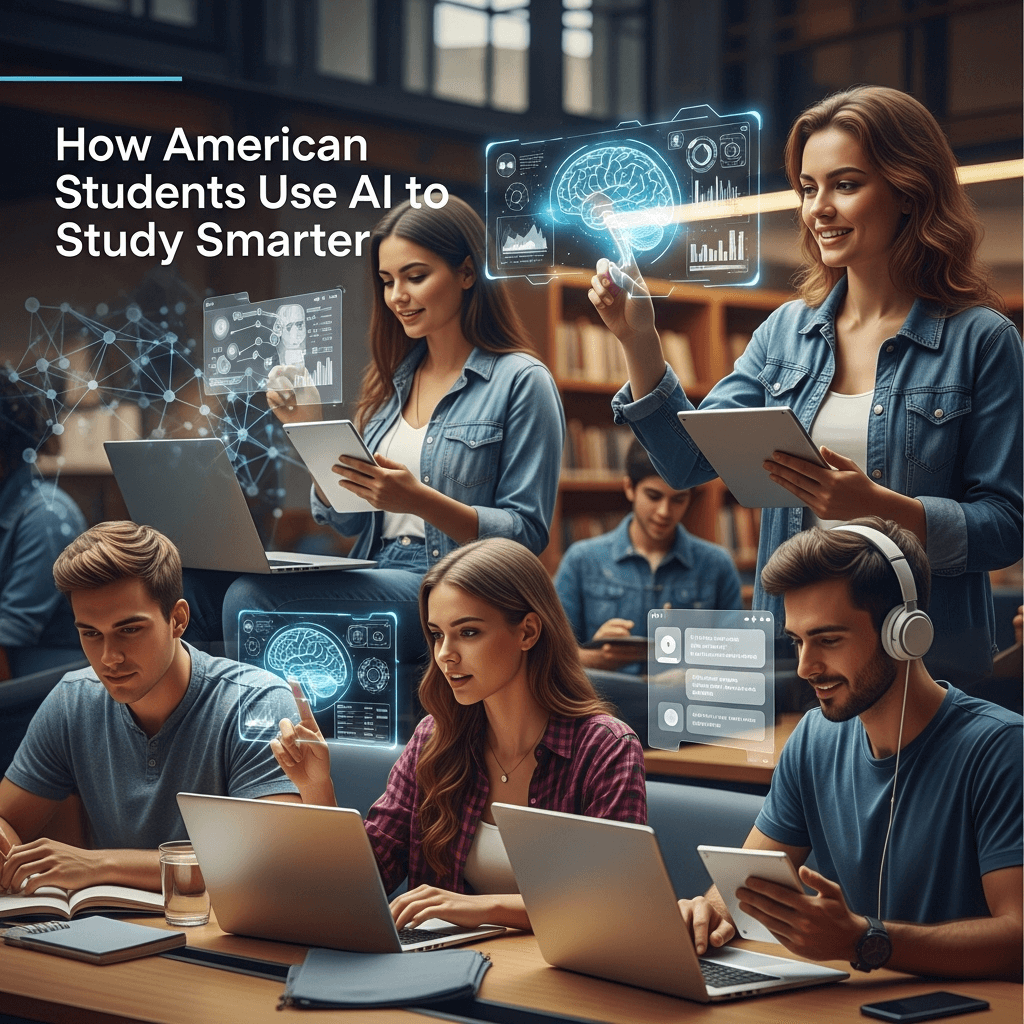

The landscape of American education has undergone a seismic shift as we move further into 2026. What began as a cautious exploration of generative tools has matured into a sophisticated ecosystem where artificial intelligence is not just an accessory but a foundational element of the academic journey. For the modern American student, studying smarter no longer means simply working harder or putting in more hours. Instead, it involves the strategic integration of advanced machine learning models, personalized learning algorithms, and real time data synthesis to achieve superior learning outcomes.
- The State of AI Adoption in US Education for 2026
- Personalized Learning Pathways: The End of One Size Fits All
- The Essential AI Toolkit for the Modern Student
- 1. Google Gemini 3 and NotebookLM
- 2. ChatGPT 5 and the Canvas Interface
- 3. Perplexity AI for Verified Research
- 4. Wolfram Alpha for STEM Precision
- Case Studies: Innovation in American Higher Education
- How to Optimize Your Study Routine with AI
- The Ethical Boundary: Academic Integrity in 2026
- Preparing for the AI Enabled Workforce
- The Economic Impact of Smarter Studying
- Challenges and the Human Element
- Daily Information and Real Time Trends (January 21, 2026)
- Final Thoughts for the 2026 Student
This comprehensive guide explores the intricate ways university and high school students across the United States are leveraging these technologies to redefine success. From the ivy-clad halls of the Northeast to the innovative tech hubs of the West Coast, the narrative is clear: those who master the art of AI assisted learning are gaining a significant competitive edge in both their academic and professional futures.
The State of AI Adoption in US Education for 2026

As of January 2026, the adoption rates for AI tools among American students have reached unprecedented levels. Recent data from national education surveys indicates that approximately 92 percent of university students now utilize at least one AI driven platform as part of their regular study routine. This is a substantial increase from the 66 percent reported in 2024, signaling that the “early adopter” phase has ended and we are now in an era of universal integration.
The surge is not limited to higher education. In high schools across the country, over 51 percent of students are using generative tools for tasks ranging from brainstorming essay topics to solving complex calculus problems. Educational leaders have largely moved away from the “ban and block” mentality that dominated 2023, choosing instead to implement robust AI literacy programs that teach students how to use these tools ethically and effectively.
Demographic Shifts and Discipline Trends
Interestingly, the way students interact with these technologies varies significantly by field of study. STEM students (Science, Technology, Engineering, and Mathematics) remain the most frequent users, with a staggering 91 percent adoption rate. These students often use AI for debugging code, simulating scientific experiments, and visualizing multi dimensional data.
Conversely, students in the humanities and social sciences are finding unique ways to utilize the technology. Rather than using AI to write their essays, which many institutions now treat as a violation of academic integrity, they are using it for “augmentation.” This includes synthesizing hundreds of pages of historical texts, generating counterarguments for debate preparation, and organizing complex research bibliographies.
Personalized Learning Pathways: The End of One Size Fits All
The most significant way American students are studying smarter is through the creation of personalized learning pathways. In the traditional classroom model, a single lecture is delivered to dozens or hundreds of students regardless of their individual learning speeds or styles. In 2026, students are using AI to bridge this gap.
Adaptive Tutoring Systems
Tools like Khan Academy’s advanced AI tutors and specialized university platforms now offer 24/7 support that functions as a private mentor. These systems can identify exactly where a student’s understanding of a concept like quantum mechanics or organic chemistry begins to falter. By analyzing the student’s responses in real time, the AI can adjust the difficulty level, provide alternative explanations, or offer supplementary resources that cater to the student’s specific weaknesses.
Audio Overviews and Multimodal Learning
The rise of “Audio Overviews” has transformed the daily commute for thousands of American students. By feeding lecture notes or textbook chapters into platforms like NotebookLM or the latest Gemini 3 models, students can generate podcast style discussions about their course material. This allows for passive learning during gym sessions or drives, helping to reinforce concepts through auditory repetition.
The Essential AI Toolkit for the Modern Student
To understand how students are succeeding, we must look at the specific tools that have become staples in the American academic toolkit. These platforms are selected for their accuracy, reliability, and ability to handle high level academic tasks.
1. Google Gemini 3 and NotebookLM
Google’s recent collaborations with major institutions, such as the University of Oxford and several large US state universities, have brought Gemini 3 to the forefront. This model is specifically grounded in learning science. Students use it for “Deep Research,” a feature that can formulate multi step research plans, browse hundreds of academic sources, and synthesize them into a cited report within minutes.
NotebookLM, in particular, has become a favorite for its ability to act as a localized research partner. By uploading a specific set of PDFs (such as a semester’s worth of reading), students can “chat” with their sources, ensuring that the AI’s answers are strictly based on the provided curriculum rather than general web knowledge.
2. ChatGPT 5 and the Canvas Interface
OpenAI’s latest iterations have introduced “Canvas,” a collaborative workspace that allows students to work alongside the AI in real time. For American students, this is used for iterative drafting. A student might write a paragraph, ask the AI to suggest a more academic tone, and then manually refine the output. This collaborative approach focuses on “augmentation” rather than “automation,” a key distinction in 2026 academic standards.
3. Perplexity AI for Verified Research
Perplexity has solidified its place as the go to “search engine” for students who require citations. Unlike traditional search engines, it provides direct answers to complex questions, backed by a list of verified academic and news sources. This is crucial for students who need to ensure the factual accuracy of their work before submission.
4. Wolfram Alpha for STEM Precision
While LLMs are powerful, they can still struggle with high level mathematics. American STEM students continue to rely on Wolfram Alpha’s computational intelligence. By integrating Wolfram’s precise math capabilities with the conversational interface of AI, students can get step by step explanations for complex equations without the risk of “hallucinations” or calculation errors.
Case Studies: Innovation in American Higher Education
Several American institutions are leading the way in integrating these tools into the campus fabric, providing a blueprint for the future of education.
The University of Arkansas Model
In January 2026, the University of Arkansas expanded its approved AI resources to include a suite of tools for all students and faculty. By providing centralized access to Copilot for Microsoft 365 and Google Gemini, the university ensures that all students, regardless of their financial background, have access to the same high level technology. This move aims to close the “digital divide” and prepare students for an AI integrated workforce.
Ivy League Integration
At elite institutions, the focus has shifted toward “AI Ethics and Literacy.” Professors are increasingly designing assignments that are “AI resistant” by focusing on critical thinking, personal reflection, and oral examinations. However, they also encourage students to use AI for data analysis and literature reviews. Recent studies at these colleges show that students use AI more for understanding complex theories (70 percent) than for simply trying to improve their grades.
How to Optimize Your Study Routine with AI
For students looking to implement these strategies today, the following workflow represents the “best practice” for 2026:
- Phase 1: Knowledge Synthesis. Use a tool like NotebookLM to upload all course materials. Ask the AI to identify the five most important themes for the upcoming exam.
- Phase 2: Deep Research. Use Gemini 3 or Perplexity to find additional peer reviewed sources that challenge or support the themes identified in Phase 1.
- Phase 3: Active Recall. Use AI to generate custom flashcards or practice quizzes based specifically on your class notes.
- Phase 4: Writing Augmentation. Draft your research paper in a collaborative environment like ChatGPT Canvas or Google Docs with Gemini. Focus on refining your arguments and ensuring proper citation.
- Phase 5: Audio Reinforcement. Convert your final notes into an audio summary to listen to during “dead time” throughout the day.
The Ethical Boundary: Academic Integrity in 2026
The rise of these tools has inevitably led to a redefinition of “cheating.” In 2026, the consensus among most American universities is that the use of AI for research, brainstorming, and editing is acceptable, provided it is disclosed. However, submitting purely AI generated work as one’s own remains a severe violation.
Universities have invested heavily in “Authentic Assessment” methods. This includes:
- In class handwritten essays. To ensure the student’s own voice is developing.
- Oral defenses of written papers. To verify the student truly understands the material.
- AI disclosure statements. Where students must explain exactly which tools they used and how they contributed to the final project.
Preparing for the AI Enabled Workforce
One of the primary reasons American students are so eager to adopt these tools is the reality of the 2026 job market. Employers now expect “AI Literacy” as a standard skill, alongside traditional competencies. By using these tools to study, students are effectively training for their future careers.
Whether it is a marketing student using AI to analyze consumer data or a pre med student using it to keep up with the latest clinical trials, the ability to work alongside machine intelligence is the most valuable asset a graduate can possess. Research from the World Economic Forum suggests that by late 2026, over 80 percent of professional roles will require some level of AI proficiency.
The Economic Impact of Smarter Studying
The move toward AI assisted learning also has significant financial implications. With the cost of higher education continuing to rise, students are using AI to maximize the value of their tuition. By using AI tutors instead of expensive private tutoring services, students are saving thousands of dollars per semester. Furthermore, the efficiency gains allowed by these tools often enable students to complete their degrees faster or balance their studies with part time professional work more effectively.
Challenges and the Human Element
Despite the overwhelming benefits, the transition has not been without its hurdles. Educators warn of the “Learning Gap,” where a reliance on AI could lead to a decrease in fundamental critical thinking skills if not managed correctly. There is also the concern of “algorithmic bias,” where AI models may prioritize certain perspectives over others.
To combat this, American students are being taught to “question the AI.” The most successful students in 2026 are those who treat AI as a junior research assistant whose work must always be double checked, rather than an infallible oracle.
Daily Information and Real Time Trends (January 21, 2026)
On this day, several key updates are influencing how students across the United States are utilizing technology:
- Google AI Pro for Students: A new offer has been extended until January 31, 2026, allowing students to access Gemini 3 Pro and 2TB of storage for free for one year. This includes the new “Deep Research” and “Audio Overview” features.
- Institutional Adoption: More universities have announced the integration of “AI Agents” into their Learning Management Systems (LMS), allowing for automated grading and instant feedback on practice assignments.
- STEM Breakthroughs: New specialized models for organic chemistry and advanced physics have been released, showing a 15 percent increase in accuracy over general models like GPT-4o.
Final Thoughts for the 2026 Student
The journey toward academic excellence in the age of artificial intelligence is about finding the perfect balance between human intuition and machine efficiency. As American students continue to push the boundaries of what is possible, the definition of a “smart student” is evolving. It is no longer about who can memorize the most facts, but who can synthesize information, think critically about data, and leverage the most advanced tools to solve the world’s most pressing problems.
The transition to AI assisted learning is not just a trend: it is the new standard. By embracing these tools today, students are not only surviving the rigors of modern academia but are thriving in a world that is being fundamentally reshaped by technology.
https://aiclassmates.com/category/ai-for-students-in-usa