

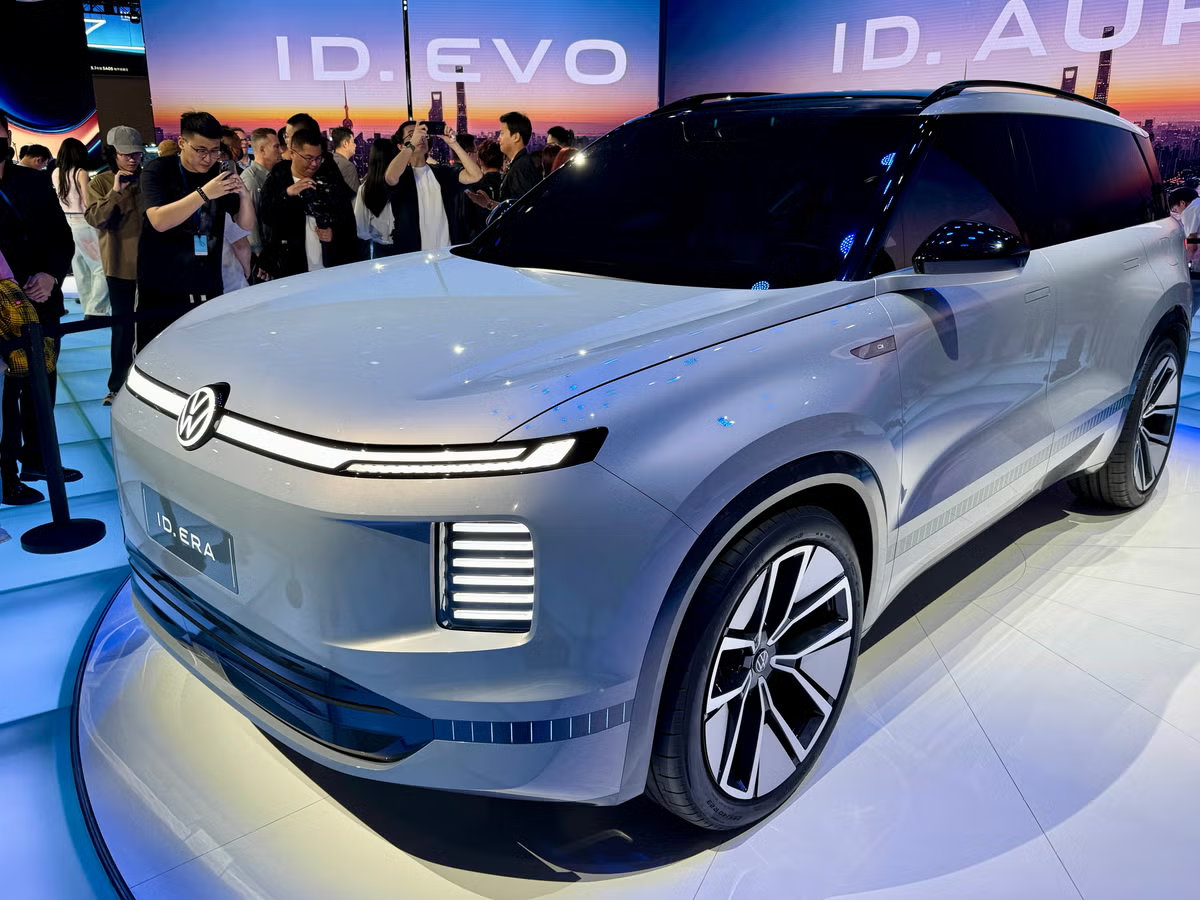

The automotive landscape in the United States is undergoing a seismic shift, and Volkswagen is positioning itself at the forefront of this transformation. While the initial wave of electrification focused almost exclusively on battery electric vehicles (BEVs), a new reality is setting in. Range anxiety, charging infrastructure gaps, and the specific demands of American drivers are pushing manufacturers to rethink their strategies. Volkswagen is now eyeing a “new type” of EV for the U.S. market, a move that could bridge the gap between traditional internal combustion engines and a fully electric future. This strategy centers on the Extended-Range Electric Vehicle (EREV), a technology that promises to solve the most significant pain points of EV ownership while delivering the performance and utility that American buyers demand.
- The Strategic Pivot to Extended-Range EVs
- Scout Motors: The Vanguard of VW’s New Strategy
- Financial Implications of Owning a High-Tech EREV
- Securing Auto Loans for High-Value Electric Trucks
- Insurance Considerations for Electric Utility Vehicles
- Navigating the 2025 Federal EV Tax Credit Landscape
- Charging Infrastructure and Technology
- Market Competition: VW vs. Rivian vs. Detroit
- Conclusion: A Pragmatic Path Forward
The Strategic Pivot to Extended-Range EVs
Volkswagen has historically been a staunch advocate for pure electrification. However, recent market dynamics have prompted a strategic reevaluation. Reports indicate that Volkswagen is seriously considering introducing EREVs to the North American market to support its existing lineup of ID. models. This technology is distinct from traditional plug-in hybrids (PHEVs). In a PHEV, the gas engine drives the wheels alongside the electric motor. In an EREV, the wheels are driven exclusively by electric motors, while a small gasoline engine acts solely as an onboard generator to recharge the battery when it runs low.
This approach addresses the primary hesitation for U.S. consumers: range anxiety. By offering a vehicle that drives like an electric car with instant torque and smooth acceleration but carries a “safety net” in the form of a gas generator, Volkswagen aims to capture a demographic that is interested in EVs but not yet ready to rely entirely on the public charging grid. This is particularly relevant for the truck and large SUV segments, where towing and hauling can drastically reduce the range of a pure battery electric vehicle.
Scout Motors: The Vanguard of VW’s New Strategy
The most concrete evidence of this shift comes from Volkswagen’s revived Scout Motors brand. Scout has officially unveiled its new lineup, the Traveler SUV and the Terra pickup, both of which will be available with a range-extender option known as the “Harvester.” This system is a game-changer for the adventure and utility vehicle market.
Performance Meets Practicality
The specs for these new vehicles are impressive and directly target the high-performance truck segment currently dominated by Rivian and Ford.
- Acceleration: 0 to 60 mph in as little as 3.5 seconds.
- Torque: An estimated 1,000 lb-ft, providing immense towing capability.
- Range: Pure electric models target up to 350 miles, while the range-extended versions (EREV) are projected to exceed 500 miles.
This 500-mile range is a critical metric. For commercial buyers and outdoor enthusiasts, the ability to drive long distances without stopping for 45 minutes to charge is a significant value proposition. The “Harvester” range extender ensures that drivers can tow heavy loads a scenario where EV range typically drops by 50 percent without the constant fear of being stranded.
Sources:
- Autoblog: Volkswagen Eyes a New Type of EV
- Car and Driver: 2028 Scout Traveler Details
- TopElectricSUV: Scout Traveler SUV & Terra Pickup Specs
Financial Implications of Owning a High-Tech EREV
For potential buyers, the shift to advanced EREVs like the Scout Terra or future VW SUVs brings complex financial considerations. Understanding the total cost of ownership is essential, particularly regarding financing, insurance, and tax incentives.
Securing Auto Loans for High-Value Electric Trucks
The projected price points for these new vehicles ranging from $50,000 to over $70,000 place them in the premium category. Securing favorable auto loan rates for such a significant investment requires a strategic approach.
- Credit Tier Management: Buyers with credit scores above 740 will qualify for the most competitive interest rates. Given the high principal amount, even a 0.5 percent difference in APR can result in thousands of dollars in savings over a 72-month term.
- Loan-to-Value (LTV) Ratios: Because EVs and EREVs are evolving technologies, lenders may scrutinize the depreciation curves differently than standard gas trucks. A substantial down payment helps maintain a healthy LTV ratio, protecting the borrower from negative equity.
- Leasing vs. Buying: Leasing may become a preferred option for many. It offers a hedge against potential technology obsolescence and battery degradation concerns. Furthermore, leasing structures often allow the manufacturer to pass through commercial tax credits directly to the consumer as a capital cost reduction, lowering monthly payments significantly.
Insurance Considerations for Electric Utility Vehicles
Insuring a high-performance, high-torque electric truck differs significantly from insuring a standard crossover. Insurance premiums for vehicles like the Scout Traveler or a potential electric VW pickup are influenced by several high-cost factors.
- Repair Complexity: Repairing aluminum body panels, advanced sensor arrays, and high-voltage battery systems requires specialized labor. Labor rates for EV-certified technicians are typically higher than general mechanics, driving up collision claim costs.
- Replacement Values: In the event of a total loss, the payout reflects the high market value of the vehicle. Insurers calculate premiums based on this risk exposure.
- Performance Metrics: Vehicles capable of 0-60 mph in 3.5 seconds are statistically categorized as higher risk. Owners should expect premiums comparable to luxury sports cars or heavy-duty diesel trucks.
- Gap Insurance: Given the rapid depreciation that can sometimes affect the EV sector, Gap Insurance is a critical product for buyers financing more than 80 percent of the vehicle’s value. It covers the difference between the vehicle’s cash value and the outstanding loan balance in the event of a total loss.
Sources:
Navigating the 2025 Federal EV Tax Credit Landscape
The financial viability of these vehicles is often tied to federal incentives. As of 2025, the landscape for the Clean Vehicle Credit continues to evolve.
- Domestic Assembly Requirements: To qualify for the full $7,500 credit, vehicles must be assembled in North America. Volkswagen’s production facility in Chattanooga, Tennessee, and Scout’s new plant in South Carolina position them well to meet this requirement.
- Battery Sourcing: Stricter guidelines regarding “Foreign Entities of Concern” (FEOC) are now in effect. This means battery minerals and components must be sourced from free-trade partners. Volkswagen’s investment in Canadian mining and North American battery plants is a direct response to these regulations.
- Income Caps: Buyers must be aware of the Modified Adjusted Gross Income (MAGI) limits ($150,000 for single filers, $300,000 for joint filers) to claim the credit at the point of sale.
For the Scout EREV specifically, the classification is key. Since it relies primarily on electric propulsion and has a plug, it may still qualify for partial or full credits depending on its battery size and the specific legislative definitions of “plug-in hybrid” versus “extended range EV” applicable in the tax year of delivery.
Sources:
- Edmunds: Electric Vehicle Tax Credits 2025 Guide
- Jim Ellis VW: Federal EV Tax Credit Expiration Dates
Charging Infrastructure and Technology
A major selling point for Volkswagen’s new strategy is the integration of the North American Charging Standard (NACS). Future VW and Scout vehicles will natively support the Tesla Supercharger network, granting owners access to the most reliable charging infrastructure in the country.
- 800-Volt Architecture: The Scout vehicles will utilize an 800-volt architecture, allowing for rapid charging speeds up to 350 kW. This future-proofs the vehicle, ensuring that as public chargers get faster, the vehicle can utilize that speed.
- Bi-Directional Charging: The ability to use the truck to power a home (V2H) or tools (V2L) is a high-demand feature. This turns the vehicle into a mobile energy storage unit, adding value for homeowners concerned about grid stability or contractors needing power at remote job sites.
Market Competition: VW vs. Rivian vs. Detroit
Volkswagen is not entering a vacuum. The decision to explore EREVs and launch the Scout brand is a direct counter to Rivian, which has captivated the “lifestyle adventure” market, and the legacy Detroit automakers (Ford, GM) who dominate the truck space.
- Rivian R1T and R1S: These are the benchmarks. However, Rivian currently lacks a range-extender option, leaving a gap for VW to exploit for customers who tow heavy trailers long distances.
- Ram 1500 Ramcharger: Ram is also launching an EREV truck. This confirms that the industry sees the “series hybrid” or EREV powertrain as the bridge solution for heavy vehicles. VW’s entry validates this as a legitimate sub-segment of the EV market.
Conclusion: A Pragmatic Path Forward
Volkswagen’s exploration of a “new type” of EV for the U.S. market represents a maturation of the electric vehicle industry. It is an acknowledgment that a “one size fits all” battery-electric approach does not work for every use case, particularly in a country as vast as the United States. By combining the driving dynamics of an EV with the range security of a gasoline generator, and backing it with robust manufacturing in South Carolina and Tennessee, Volkswagen is positioning itself to capture high-value market share. For consumers, this means more choice, better utility, and a vehicle that truly fits the multi-faceted demands of American life. As 2025 progresses, keeping a close eye on the financing rates, insurance premiums, and tax credit eligibility for these specific models will be crucial for any prospective buyer looking to make a smart automotive investment.