


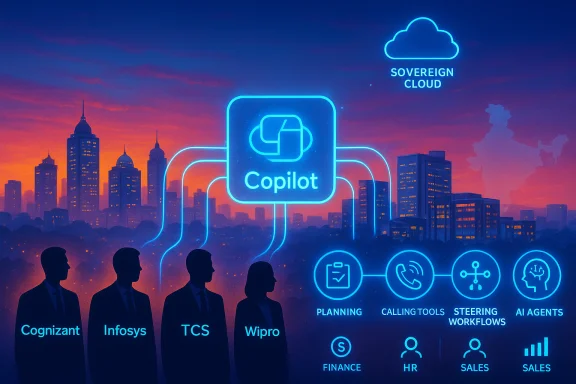

The global landscape of enterprise software development and digital consultancy reached a historic turning point in December 2025. During a high-profile visit to Bengaluru, Microsoft CEO Satya Nadella announced a series of landmark partnerships that effectively redefine the scale of artificial intelligence integration in the corporate world. The core of this announcement centers on a commitment by four of India’s largest IT services giants to deploy over 200,000 Microsoft Copilot licenses. With each company, including Cognizant, Infosys, Tata Consultancy Services (TCS), and Wipro, pledging to roll out 50,000 licenses individually, the industry is witnessing the largest single adoption event of generative AI tools in history.
- Understanding the Scale: The 50,000 License Milestone
- The Strategic Investment Context: $17.5 Billion and Beyond
- Transitioning from Copilots to Autonomous Agents
- Deep Dive: Cognizant as Client Zero
- Infosys: Merging Topaz with Microsoft’s Intelligence Layer
- Wipro: Upskilling the Workforce for the AI Era
- TCS: Personalized AI Coaching at Scale
- The Economic Reality: ROI and Productivity Gains in 2025
- Industry-Specific Applications and Custom Agents
- Overcoming the Execution Gap: Governance and Trust
- The Future Outlook: Toward 2030
- Conclusion: A New Era of Professional Services
This movement is not merely about purchasing software. It represents a fundamental restructuring of how global service companies operate, deliver value, and scale innovation. The sheer volume of these deployments signals that the era of AI experimentation is over; we have officially entered the era of AI-first delivery.
Understanding the Scale: The 50,000 License Milestone
When a single organization commits to 50,000 licenses of a sophisticated intelligence tool like Microsoft Copilot, it is making a statement about its future operating model. For the Indian IT sector, which serves as the backbone of the global Fortune 500 tech infrastructure, this scale is necessary to move the needle on global productivity.
The deployment across Cognizant, Infosys, TCS, and Wipro creates a combined force of over 200,000 AI-augmented professionals. To put this in perspective, this is larger than the entire workforce of many mid-sized multinational corporations. By embedding these tools into the daily workflows of consultants, developers, and operations specialists, these firms are essentially creating a massive laboratory for enterprise-grade AI at scale.
The Strategic Investment Context: $17.5 Billion and Beyond
This massive license rollout did not happen in a vacuum. It follows Microsoft’s announcement of a staggering $17.5 billion investment in India’s cloud and AI infrastructure planned between 2026 and 2029. This represents Microsoft’s largest ever investment in Asia, designed to bolster data centers in regions like Chennai, Hyderabad, and Pune.
The local infrastructure expansion is critical because it addresses one of the primary hurdles for enterprise AI adoption: data sovereignty. Large scale deployments in the financial services and healthcare sectors require that data stays within national borders. By building the physical capacity to process AI workloads locally, Microsoft is enabling these 200,000 licenses to be used in highly regulated environments where cloud adoption was previously restricted.
Source: Artificial Intelligence News – Service Provider Implementations
Transitioning from Copilots to Autonomous Agents
A key theme of the December 2025 announcements is the shift from “Assistive AI” to “Agentic AI.” While the initial wave of Copilot adoption focused on helping individuals write emails or summarize meetings, the current strategy involves “AI Agents” that can execute multi-step work processes.
In the context of the Indian IT service providers, these agents are being designed to run complex workflows. Instead of just suggesting a line of code, an agentic system might analyze a bug report, search the entire codebase for similar issues, propose a fix, run the unit tests, and prepare a documentation draft for human review. This move from “AI helps you write” to “AI helps run workflows” is the primary driver behind the massive 50,000-license commitments.
Deep Dive: Cognizant as Client Zero
Cognizant has taken a unique position in this rollout by acting as “Client Zero” for Microsoft’s latest AI innovations. This means they are not just users; they are a primary testing ground for refining these tools before they reach the wider market.
The CEO of Cognizant, Ravi Kumar S, has emphasized that the goal is to bridge the gap between massive infrastructure investments and actual business value. By deploying 50,000 licenses, Cognizant aims to transform how its associates access data and make decisions across client engagements. The “Client Zero” strategy allows them to build proprietary playbooks for AI transformation, which they then sell to their own global clients, creating a virtuous cycle of internal efficiency and external revenue growth.
Infosys: Merging Topaz with Microsoft’s Intelligence Layer
Infosys is integrating its 50,000 Copilot licenses deeply into its existing AI-first offering, Infosys Topaz. By combining Microsoft’s intelligence layer with the Topaz Fabric and Cobalt platforms, Infosys is attempting to create a “human+agent” hybrid model.
The strategy here is to operationalize multi-agent workflows. For a global enterprise, this might mean an AI agent that monitors supply chain disruptions in real-time and automatically suggests rerouting strategies to human managers. Salil Parekh, CEO of Infosys, has noted that this scale of deployment is about shifting from traditional workflows to a completely reimagined operating model where AI is embedded in every product and service the company delivers.
Wipro: Upskilling the Workforce for the AI Era
Wipro’s commitment of 50,000 licenses is accompanied by an intensive focus on human capital. The company has already upskilled over 25,000 employees in Microsoft Cloud and GitHub technologies, with plans to double that number.
Wipro’s approach focuses on the “Software Development Life Cycle” (SDLC). By providing GitHub Copilot to tens of thousands of developers, they are targeting a 25% to 30% increase in productivity across the entire lifecycle, from initial requirement gathering to final deployment. Wipro has also established a Microsoft Innovation Hub at its Bengaluru labs to specifically develop industry-specific AI solutions for sectors like retail and manufacturing.
TCS: Personalized AI Coaching at Scale
Tata Consultancy Services (TCS) is utilizing its 50,000 licenses to provide what they call “Personalized AI Coaching.” In a workforce as vast as that of TCS, standard training programs often fall short. By using Copilot as a personalized assistant, TCS allows every employee to have a tailored learning experience that adapts to their specific role, whether they are in Sales, HR, or Finance.
TCS is particularly focused on integrating AI-led automation into its internal business functions. The goal is to prove the efficacy of these tools within their own $25 billion plus organization before implementing similar large-scale transformations for their global client base.
The Economic Reality: ROI and Productivity Gains in 2025
The decision to invest in 50,000 licenses per firm is backed by increasingly robust data regarding Return on Investment (ROI). According to recent industry reports, enterprise users of advanced AI assistants are saving an average of 40 to 60 minutes per day. For a company with 50,000 active users, this equates to roughly 40,000 hours of reclaimed productivity every single day.
Data from late 2025 suggests the following impacts across the software development lifecycle:
- Task Completion Speed: Users of AI coding assistants are completing tasks up to 55% faster.
- Code Quality: Studies indicate a 39% improvement in code readability and maintainability.
- Deployment Volume: Some firms have reported a 25% increase in the volume of code delivered into production.
Beyond simple time savings, these tools are narrowing the skill gaps within the workforce. Junior developers are now able to perform tasks that previously required mid-level expertise, while senior architects can focus on high-level system design rather than mundane debugging.
Industry-Specific Applications and Custom Agents
The 200,000 combined licenses are being leveraged to build specialized AI agents for different vertical markets. We are seeing a shift from generic chatbots to highly specialized tools:
- Financial Services: Agents that can parse thousands of pages of regulatory documents to ensure compliance in real-time.
- Healthcare: AI tools that assist in drug discovery by simulating chemical interactions or summarizing clinical trial data.
- Retail: Personalized recommendation engines that analyze individual customer behavior across multiple touchpoints to predict future purchasing intent.
- Manufacturing: Predictive maintenance agents that monitor IoT data from factory floors to prevent downtime before it occurs.
Source: Entrepreneur India – Microsoft Strategic Partnerships
Overcoming the Execution Gap: Governance and Trust
Despite the massive rollout, the transition has not been without challenges. Industry reports from Deloitte and EY in late 2025 suggest that while conviction in AI is high, there is still an “execution gap.” Approximately 61% of organizations report that only about 40% of their employees with access to AI tools are using them to their full potential.
To address this, the major Indian service providers are focusing heavily on:
- Responsible AI Frameworks: Developing strict guidelines to prevent AI bias and hallucinations.
- Data Privacy: Ensuring that enterprise data used in prompts is never leaked into public models.
- Change Management: Training employees not just how to use the tool, but how to rethink their entire workday around AI capabilities.
The “buy versus build” debate has also intensified. While 91% of leaders prefer buying established platforms like Microsoft Copilot for speed of deployment, there is an increasing demand for the ability to customize these tools with proprietary company data. This is where the service providers provide value, by building custom “plugins” or “connectors” that bridge Copilot with a client’s specific internal systems.
The Future Outlook: Toward 2030
As we look toward 2026 and beyond, the deployment of 50,000 licenses per firm is expected to become the new standard for any organization looking to remain competitive. IDC forecasts that by 2030, 50% of the new economic value generated by digital businesses in the Asia Pacific region will come from organizations that are scaling their AI capabilities today.
The investment by Microsoft, paired with the aggressive adoption by Indian IT firms, suggests that India is positioning itself as the global “AI office” of the world. With over 450,000 AI and machine learning professionals already in the country, the addition of 200,000 high-end AI licenses creates a concentration of technical talent that is unmatched globally.
Conclusion: A New Era of Professional Services
The announcement of 200,000 Copilot licenses across the Indian IT landscape is more than a news story; it is a signal of a structural change in the global economy. By equipping their workforces with the most advanced intelligence tools available, these companies are moving from a model based on “hours worked” to a model based on “outcomes delivered.”
As these 200,000 professionals begin to master agentic workflows, the speed of innovation will accelerate. For global enterprises, the question is no longer whether to adopt AI, but how quickly they can partner with these newly augmented service providers to reinvent their own business processes. The December 2025 milestone in Bengaluru will likely be remembered as the moment the AI revolution in the enterprise became real, measurable, and permanent.
Source: Tech in Asia – Indian IT Giants and Copilot
Would you like me to research specific case studies of how these 50,000 licenses are being used in the financial or healthcare sectors specifically?