


The digital landscape is shifting beneath our feet, not in geological time, but in real-time. We are currently navigating an industrial revolution powered not by steam or electricity, but by cognition. The rapid integration of artificial intelligence across every sector is no longer a futuristic concept; it is the defining operational reality of the current decade. For organizations and professionals striving for longevity and market leadership, the message is clear: adaptation is mandatory.
The central challenge facing the modern workforce is not merely adopting new technology but fundamentally understanding it. The defining characteristic of successful enterprises in the coming years will be their commitment to deep-seated AI literacy and a culture of perpetual learning. As noted in recent industry analyses, including insights from Artificial Intelligence News, the correlation between AI fluency in the workplace and sustainable business growth is becoming undeniable. We are moving past the phase of novelty and into the phase of strategic necessity.
This deep dive explores why static knowledge is now a liability and why building a continuously learning infrastructure dedicated to algorithmic understanding is the most critical investment an organization can make today.
The Seismic Shift: Beyond Automation to Augmentation
For decades, technology in the workplace primarily focused on automation: taking repetitive, manual tasks and digitizing them for speed and accuracy. We understood this paradigm. A spreadsheet calculated faster than a human with a calculator; a robotic arm assembled parts faster than a human hand.
Generative AI and advanced machine learning models have fundamentally altered this dynamic. We are no longer just automating muscle; we are beginning to automate and augment cognition. Today’s AI tools are capable of drafting complex legal documents, analyzing vast datasets for nuanced market trends, generating photorealistic marketing assets, and even writing functional software code.
This shift means that the “users” of technology must evolve into “collaborators” with technology. A workforce that only knows how to push buttons on a legacy system is ill-equipped to leverage tools that require precise prompting, critical evaluation of outputs, and strategic integration into complex workflows.
The danger here is a widening chasm between organizations that merely deploy AI and those that truly understand it. Deploying AI without literacy leads to misused tools, misinterpreted data, and significant ethical risks. Understanding AI leads to unprecedented efficiency gains, novel product development, and a decisive competitive advantage in a crowded marketplace.
Defining AI Literacy in the Modern Economy
A critical misconception hindering progress is the belief that “AI literacy” means turning every employee into a data scientist or a Python engineer. This is patently false and an inefficient use of human capital.
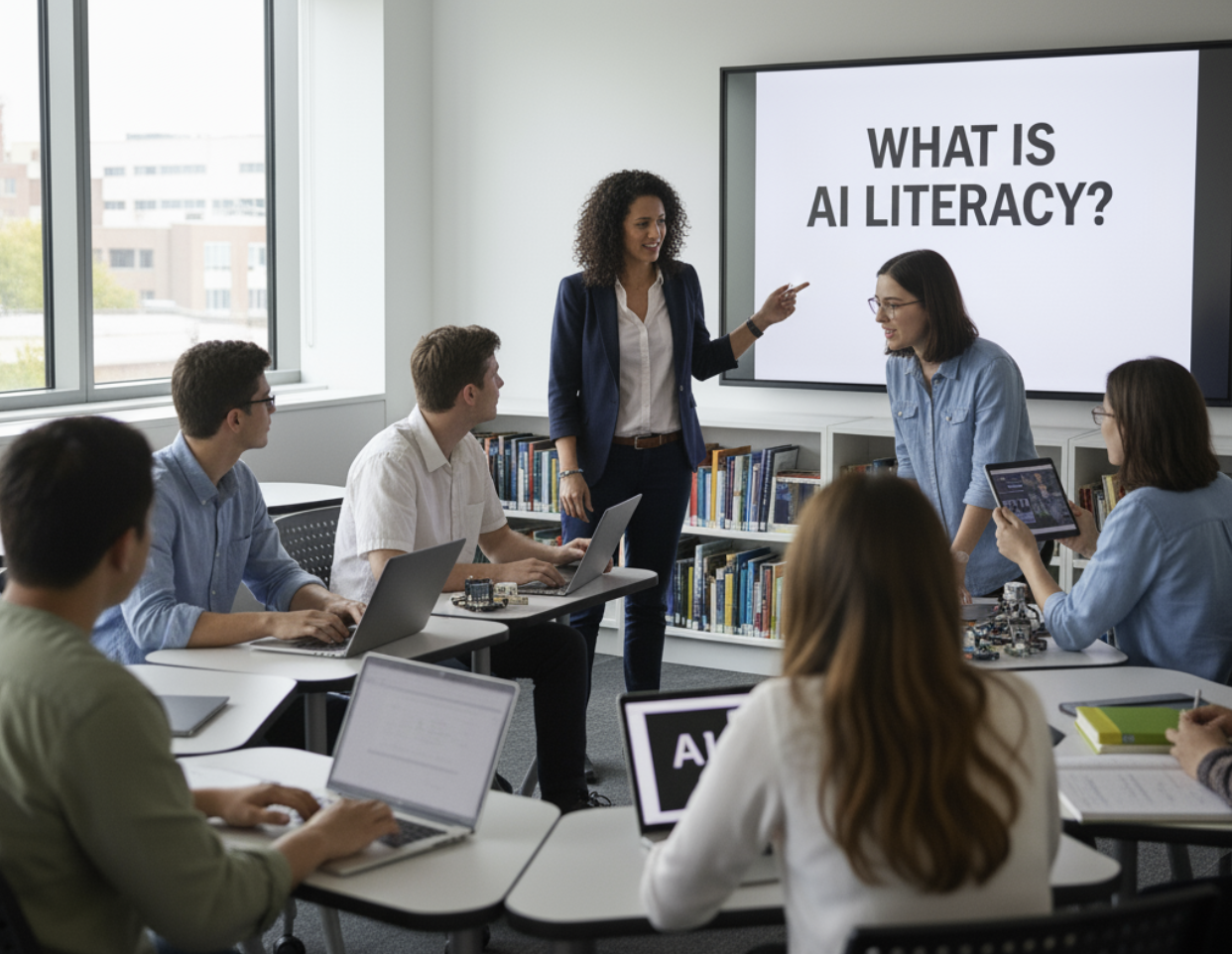
True AI literacy in a business context is multi-layered. It is about fluency, functional understanding, and strategic application. It is the ability of a workforce to look at a business problem and instinctively understand where an AI solution might apply, what its limitations are, and how to interpret its results.
The Managerial and Executive Layer
For leadership, AI literacy means understanding the strategic implications of the technology. It involves recognizing how machine learning can reshape business models, alter supply chains, or personalize customer experiences at scale. It also requires a firm grasp of AI governance, ethics, and the regulatory landscape that is quickly forming around these technologies. Executives must be literate enough to ask the hard questions about data privacy, algorithmic bias, and the ROI of AI investments.
The Operational Layer
For operational roles, literacy means practical capability. It is the knowledge of how to effectively prompt a generative AI model to get the desired output for a marketing campaign or a financial report. It is the ability to look at an AI-generated forecast and apply human intuition and contextual knowledge to validate it before making a capital-intensive decision.
When we discuss AI literacy as a cornerstone for growth, as highlighted in broader industry discussions, we are talking about empowering employees at all levels to stop viewing AI as a “black box” that magically produces answers. Instead, they must view it as a sophisticated instrument that requires skill to wield effectively.
The Economic Imperative of Continuous Upskilling
The half-life of a technical skill is shrinking rapidly. What was cutting-edge knowledge five years ago is often obsolete today. In the realm of AI, this timeline is compressed even further. New models, new capabilities, and new best practices emerge on a weekly basis.
Consequently, the traditional model of education where you learn a trade or profession once in your youth and apply it for forty years is fundamentally broken. It is a relic of the industrial age that cannot support the demands of the intelligence age.
Businesses that treat training as a one-time onboarding event or an annual compliance seminar are destined to stagnate. The return on investment (ROI) for continuous education is no longer just about employee retention or morale; it is directly tied to operational efficiency and revenue generation.
The Cost of Ignorance
Consider the cost of not upskilling. An organization with low AI literacy will inevitably fall behind. Their competitors will use generative design to bring products to market faster. They will use predictive analytics to optimize inventory and free up working capital. They will use AI-driven customer support to provide superior service at a lower cost.
The cost of ignorance is lost market share and irrelevance. Investing in continuous education is expensive, but ignorance is far more costly in the long run. The gap between the AI-haves and the AI-have-nots will not be measured just in technology ownership, but in human capability.
Building the Infrastructure for Perpetual Learning
Recognizing the need for continuous education and AI literacy is step one. Executing it within a complex organizational structure is the real challenge. It requires a move away from sporadic workshops toward an integrated infrastructure of learning.
Shifting Cultural Mindsets
The biggest barrier to AI adoption is often human, not technical. There is a palpable fear among workforces that AI is here to replace them. If leadership frames AI as solely a cost-cutting mechanism, this fear will paralyze progress.
The narrative must shift from replacement to augmentation. Continuous education should be framed as an investment in the employee’s future value, equipping them with the tools to act as the “pilot” of these powerful systems. When employees see that learning AI skills makes their jobs less monotonous and more strategic, resistance turns into curiosity.
Micro-Learning and Just-in-Time Education
The era of pulling employees out of production for week-long seminars is fading. The modern workflow demands “just-in-time” learning. This involves creating repositories of micro-learning contentn short, focused modules that an employee can access the moment they face a specific challenge.
If a marketing manager needs to use a new generative image tool for a campaign, they shouldn’t need to wait for next quarter’s training schedule. They need immediate access to a fifteen-minute module on best prompting practices for that specific tool. This approach integrates learning directly into the flow of work, making it relevant and immediately applicable.
Creating Safe Sandbox Environments
Theoretical knowledge of AI is insufficient. Mastery requires practice. Organizations must provide “sandbox” environments where employees can experiment with AI tools without fear of breaking critical systems or leaking sensitive data.
These controlled environments allow teams to test hypotheses, make mistakes, and learn the practical limits of the technology. A financial analyst needs a safe space to see what happens when they feed different datasets into a predictive model, learning how sensitive the outputs are to data quality without risking real capital. This experiential learning is where real literacy is forged.
The Future Landscape: The Human-AI Partnership
As we look toward the horizon, it becomes clear that the most successful organizations will not be fully automated entities run by algorithms. They will be hybrid organizations characterized by high-bandwidth partnerships between human intelligence and artificial intelligence.
The humans in this loop will provide the essential qualities that AI currently lacks: empathy, high-level strategic intent, ethical reasoning, and complex contextual understanding. The AI will provide speed, scale, data processing power, and pattern recognition that far exceeds human capability.
The bridge between these two forces is literacy. Without it, the partnership fails.
We are heading toward a future where “learning how to learn” is the single most valuable skill a professional can possess. The specifics of the technology will change. Today it is large language models; tomorrow it may be quantum-assisted machine learning or highly specialized autonomous agents. The specific tools are transient, but the necessity for rapid adaptation is permanent.
By establishing AI literacy and continuous education as foundational cornerstones now, businesses are not just solving immediate operational problems. They are future-proofing their organizations. They are building the intellectual resilience necessary to navigate a future where the only constant is accelerating change. This is the new imperative for sustainable growth in the 21st-century economy.