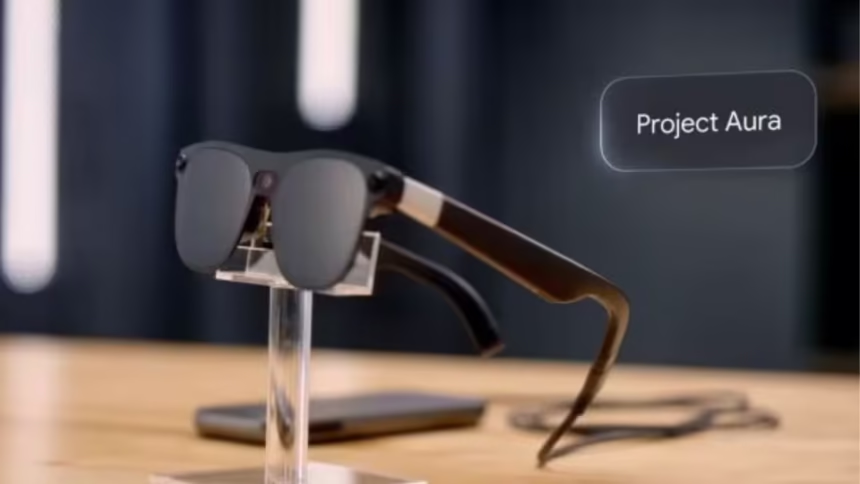



The global technology landscape is undergoing a radical shift, moving beyond the confines of the handheld smartphone and into the expansive, dynamic realm of spatial computing. At the epicenter of this next-generation revolution stands Project Aura, the groundbreaking collaboration between Google and XREAL. Unveiled as the vanguard of the Android XR platform, Project Aura is not merely a smart gadget; it is the most credible blueprint yet for how we will interact with the digital world in a truly seamless, everyday wearable form factor.
- The Dawn of Lightweight Extended Reality (XR)
- Technical Specifications and Breakthroughs in Display Technology
- Transforming Industries: Use Cases for Project Aura
- The Portable Productivity Powerhouse
- Advanced Navigation and Travel Assistance
- Next-Generation Entertainment and Media Consumption
- The Developer Ecosystem: Building the Android XR Future
- Privacy and Ethics in the Augmented World
- The Road to 2026: Anticipation and Market Impact
- Source Links and Further Reading
This exclusive, comprehensive first look examines the intricate engineering, the immense developer opportunity, and the transformative potential of Project Aura, which promises to normalize mixed reality and reshape sectors from enterprise productivity to global entertainment.
The Dawn of Lightweight Extended Reality (XR)
For years, the dream of an accessible, comfortable, all-day augmented reality (AR) device has been hampered by bulky hardware, limited battery life, and a fragmented software ecosystem. While fully immersive headsets like Samsung’s Galaxy XR (formerly Project Moohan) or competitors like the Apple Vision Pro offer unparalleled high-fidelity experiences, they are fundamentally designed for isolated, high-focus sessions. Project Aura, slated for a full commercial launch in 2026, represents a calculated strategic pivot: bringing the powerful capabilities of the Android XR ecosystem into a form factor that closely resembles conventional eyewear.
Engineered for All-Day Utility
The core innovation of Project Aura lies in its split-compute design. The glasses themselves are kept remarkably light, designed to be worn for extended periods without the physical fatigue associated with full headsets. This portability is achieved by offloading the intensive processing and battery to a separate, tethered puck. This computing unit, which is small enough to clip to a belt or slip into a pocket, houses the potent Qualcomm Snapdragon XR2 Plus Gen 2 chipset—the very same high-performance silicon driving the full-scale Galaxy XR headset.
This strategic division of labor yields several crucial advantages:
- Ergonomics and Comfort: The reduction in onboard weight makes Project Aura a far more viable candidate for daily use, bridging the gap between niche tech gadget and mass-market consumer electronics.
- Thermal Management: Separating the heat-generating processor and battery from the optics and display ensures the device remains cool and comfortable against the face.
- Sustained Performance: The larger size of the external puck allows for a more substantial battery, addressing one of the most significant pain points of current-generation smart glasses: limited operational uptime.
The design philosophy is clear: Project Aura is intended to be a practical, on-the-go workspace and assistant, perfect for tasks like travel, on-site diagnostics, or simply managing notifications without needing to constantly reach for a smartphone.
Technical Specifications and Breakthroughs in Display Technology
XREAL’s extensive heritage in producing high-quality AR glasses is the foundation of Project Aura’s optical system, leading to several headline-grabbing technical features that set it apart in the emerging XR market.
The 70-Degree Optical See-Through Field of View (FOV)
One of the most impressive specifications is the 70-degree field of view. This is touted as the largest optical see-through display XREAL has ever delivered. For the user, this translates to a massive, private, and highly legible screen layered directly onto the physical world. This is achieved using XREAL’s proprietary X-Prism optical system and Micro OLED displays within the lenses.
The optical see-through (OST) technology is critical. Unlike video passthrough systems used in some competitor devices, OST allows the user to see the real world directly through the transparent lenses. The digital content—text, virtual monitors, 3D models—is then projected onto these lenses, maintaining a direct, clear connection to the environment. This makes Project Aura highly suitable for mixed-reality applications where spatial awareness is paramount.
The Convergence of Android XR and Gemini AI
The real powerhouse of Project Aura is the software platform: Android XR tightly integrated with Google Gemini. The adoption of Android XR is a watershed moment for the extended reality industry, promising to overcome the dreaded challenge of ecosystem fragmentation.
- Seamless App Portability: Because Project Aura runs on Android XR, it instantly gains compatibility with the full suite of apps developed for the Galaxy XR headset. Developers can create a single application that runs flawlessly across both high-immersion headsets and lightweight glasses, dramatically accelerating content creation and ecosystem growth.
- Gemini as the Contextual AI Assistant: The embedded cameras, microphones, and sensors in Project Aura give the Gemini multimodal AI assistant a real-time, first-person view of the user’s world. This enables deeply contextual assistance that transforms the glasses from a display device into an intelligent co-pilot.
- Live Translation: See subtitles for a conversation partner in a foreign language appear in your line of sight.
- Visual Search and Identification: Circle an object in your view with a simple hand gesture to instantly trigger Circle to Search, allowing Gemini to identify a plant, a landmark, or a painting and provide real-time information.
- Hands-Free Workflow: Call up a virtual desktop wirelessly streamed from your laptop, spread out multiple floating application windows, and control them using natural hand tracking and gestures without ever touching a physical mouse or keyboard.
This sophisticated AI integration is what separates Project Aura from earlier generations of smart glasses, ensuring it is a tool of utility, not a mere novelty.
Transforming Industries: Use Cases for Project Aura
The technical capabilities of Project Aura position it as a powerful device with compelling applications across high-value sectors, from professional productivity and navigation to dynamic entertainment. The focus on these high-end, high-revenue-potential use cases is a key differentiator.
The Portable Productivity Powerhouse
For the modern professional, Project Aura offers a truly mobile, infinite workspace, tapping into the lucrative market for mobile computing and remote work tools.
- Virtual Multi-Monitor Setup: The glasses can wirelessly project a massive virtual desktop from a connected laptop or PC. Users can create a customized, multi-monitor setup on a plane, in a coffee shop, or at a remote job site. Imagine having a virtual 300-inch screen for editing video in Adobe Premiere Pro or coding complex algorithms in an integrated development environment (IDE) while traveling.
- Real-Time Data Overlay for Enterprise: Field service engineers can use the glasses to overlay complex technical schematics onto a piece of equipment, receiving step-by-step guidance for repairs or maintenance. Medical professionals could potentially view patient data or pre-operative scans directly in their line of sight during procedures, an application that demonstrates immense value in high-stakes environments.
- Seamless Communication: With integrated Google Meet and messaging functionalities, an incoming video call can appear as a floating window, allowing the user to answer with a tap and share their own perspective through the glasses’ cameras for hands-on troubleshooting or collaboration.
Advanced Navigation and Travel Assistance
The combination of the optical see-through display and GPS/map integration offers a revolutionary approach to personal navigation and travel.
- Augmented GPS Directions: Turn-by-turn directions from Google Maps are projected directly into the user’s view, eliminating the need to look down at a phone screen. The digital arrows and distance markers merge with the real environment, providing an intuitive, heads-up display for walking, cycling, or driving.
- Contextual Airport/Transit Guidance: The glasses can dynamically display an airport map, guiding the user to their gate or baggage claim with virtual pathways overlaid on the floor. An Uber widget can appear in the view, triggered by the regular Android app, pointing the user directly to the pickup point. This enhances safety and efficiency in complex public spaces.
- Instant Information Access: Looking at a flight departure board can trigger Gemini to highlight the user’s specific flight and gate changes in real-time. This level of personalized, contextual data delivery is invaluable to frequent business and luxury travelers.
Next-Generation Entertainment and Media Consumption
While designed for productivity, Project Aura’s immersive display is a major boon for entertainment, a sector that consistently drives high advertising and subscription revenues.
- Cinematic Viewing Anywhere: The massive virtual screen capability transforms the viewing experience, allowing users to watch 3D YouTube videos or streamed movies with a cinematic feel, all while remaining aware of their physical surroundings.
- Spatial Gaming: Developers can leverage the 70-degree FOV and hand-tracking capabilities to bring spatial computing to lightweight gaming. Demos have shown users playing complex tabletop games, like the VR title Demeo, with 3D elements floating in their actual environment, manipulated entirely by natural hand gestures.
- Cross-Platform Content: The seamless integration with the Android ecosystem ensures that users can access their existing library of media and subscription services instantly.
The Developer Ecosystem: Building the Android XR Future
Google and XREAL are deliberately positioning Project Aura as a foundational piece of the larger Android XR ecosystem. The success of any new platform hinges entirely on developer adoption, and Google is taking a strategic, ecosystem-first approach to avoid the pitfalls of previous failed hardware launches.
The Three Tiers of Android XR Hardware
Google’s strategy for mainstream adoption involves a multi-tiered approach, with Project Aura representing the high-performance, tethered display category:
- AI Glasses (Audio-Only): Collaborations with brands like Warby Parker and Gentle Monster are focused on stylish, discreet eyewear with microphones, speakers, and cameras for conversational interaction with Gemini, but no in-lens display. This addresses the mass-market need for a screen-free AI assistant.
- Display AI Glasses (Wireless, In-Lens): These feature a single, optional Micro LED display in one or both lenses, providing private information like turn-by-turn directions or translation captions. They connect wirelessly to a smartphone for processing, prioritizing slim design and maximum portability.
- Project Aura (Wired XR Glasses): The powerful, high-immersion device featuring the 70-degree FOV, full hand and room tracking, and the external compute puck. This tier is optimized for professionals and power users requiring complex spatial applications and high-fidelity graphics.
Democratizing Development with Android XR SDK
Google has actively engaged the developer community by releasing iterative updates to the Android XR SDK. The latest Developer Preview releases include crucial tools that empower creators:
- Jetpack XR SDK: Features like support for 180° and 360° stereoscopic video encoding (using the MV-HEVC specification) enable developers to create truly immersive media experiences. The SpatialExternalSurface composable allows for efficient rendering of stereoscopic media within an XR application.
- Hand and Plane Tracking: Updated APIs for ARCore and the Unity OpenXR: Android XR package provide robust support for hand tracking, including the detection of 26 posed hand joints. This allows for natural, intuitive gesture-based interaction, from pinching to scroll to swiping to navigate.
- Ecosystem Convergence: XREAL CEO Chi Xu emphasized that Android XR means “developers don’t have to choose sides anymore.” By running on a unified platform, the development effort for Project Aura contributes directly to the entire Android XR landscape, from the Galaxy XR headset to the simplest audio-only glasses.
Privacy and Ethics in the Augmented World
The historical missteps of earlier smart glasses, particularly concerns around recording and privacy, have led Google and XREAL to implement strict, user-focused guardrails for Project Aura. This focus on ethical design is paramount for consumer trust and mass-market acceptance.
Transparent Camera Indicators
To prevent the “Glasshole” stigma, Project Aura incorporates clear, non-ambiguous visual cues:
- Pulsing Recording Indicator: If the glasses’ cameras are actively recording video or taking a photograph, a bright, pulsing light indicator will alert people nearby, ensuring public transparency.
- Physical Camera Switches: The device will feature clearly marked physical switches, using the intuitive red (off) and green (on) convention, giving the user immediate, tactile control over sensor access.
Security Frameworks
The glasses inherit the robust security and privacy frameworks of the underlying Android and Gemini platforms. There will be strict controls over sensor access, requiring explicit user permissions for features like real-time location tracking or camera use, aligning with established mobile device protocols.
The Road to 2026: Anticipation and Market Impact
Project Aura is scheduled for a full commercial release in 2026, a timeframe that allows Google and its partners to further refine the hardware, solidify the software ecosystem, and ensure the developer community is ready with compelling launch applications.
Strategic Market Positioning
Project Aura enters a hotly contested market, but its positioning is highly strategic:
- The AR Alternative: It serves as a more practical, everyday alternative to the high-immersion, but often bulky, VR-first headsets like the Apple Vision Pro. It is designed for everyday mixed reality, not total virtual immersion.
- Hardware Diversity: By partnering with XREAL, a leader in lightweight AR hardware, Google is validating its commitment to an open platform that supports diverse form factors, directly competing with the single-hardware strategy of competitors.
- The AI Edge: The tight integration with the world’s most advanced conversational AI, Gemini, provides a distinct competitive advantage, ensuring the glasses are useful out of the box, even before a vast third-party app ecosystem is established.
Project Aura is not just a technological advancement; it is a declaration of intent. It signals Google’s serious, refined return to the wearables space, leveraging its unparalleled strengths in AI, software platforms, and ecosystem building. The combination of XREAL’s cutting-edge optics, the power of Android XR, and the contextual intelligence of Gemini positions Project Aura to be the pivotal device that finally makes spatial computing a practical, everyday reality for the global consumer.
Source Links and Further Reading
- First Look: Project Aura — The Next Step in XR for Android XR and Gemini – Reddit/Xreal
- I Tried the New Android XR Smart Glasses From Google and XReal – PCMag
- Project Aura puts the Galaxy XR experience into a pair of lightweight glasses – Android Authority
- A first look at Google’s Project Aura smart glasses built with Xreal – Indian Express
- Google confirms first AI smart glasses launch in 2026 – Times of India
- A new look at how Android XR will bring Gemini to glasses and headsets – Google Blog